01
Measure what moved
We check how the stoop settled relative to the house, where the risers drifted out of even, and whether the slab under it can be saved or needs to go.
Sixty years of clay movement will pull a front stoop away from the house a quarter inch at a time, until the bottom step is short and the top one is a trip. We rebuild Richardson stoops, porch steps, and entry stairs with consistent risers and a finish that grips on the one week a year it ices.
Credibility comes from how it's built, not from promises. Here's the order of operations on every concrete steps & stairs job.
We check how the stoop settled relative to the house, where the risers drifted out of even, and whether the slab under it can be saved or needs to go.
The old steps come out, and we prepare a base that does not repeat the original mistake of bearing on unprepared clay.
Risers formed consistent within a tight tolerance and treads sized so people do not have to think. A stair anyone stumbles on twice was built wrong.
Steel ties the steps together so they move as a piece instead of separating tread by tread the way old unreinforced stoops do.
Broom texture on every tread as standard. Ice is rare here, but it arrives overnight when it comes, and a slick trowel finish on an entry stair is a bad trade year-round.
Most contractors vanish after the deposit. We pick up the phone, show up when we say, and stand behind the work after the truck leaves. The follow-through is the difference.
A foreman we know runs your job and a vetted crew does the work, managed by Lucky's, one company accountable from the first call to the final walkthrough.
COI and lien waivers on file before we break ground. The documentation that lets commercial clients pay and gives homeowners peace of mind.
Prepped subgrade, reinforced and mixed to spec for the job, and proper curing. We build credibility through the process, not promises. On concrete steps & stairs, that starts with measure what moved.
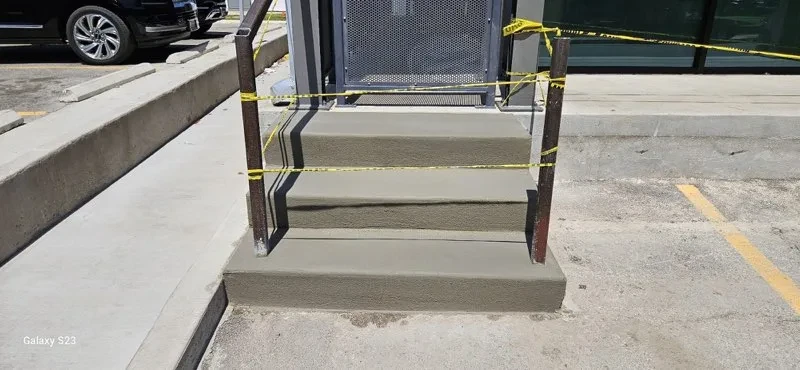
Step work in North Texas usually starts around $300-500 per step, varying with size, demolition, and how much base repair the old stoop is hiding. We firm up the number after seeing it in person; steps are exactly the kind of job where a blind phone quote goes wrong.
Depends on what moved. If the structure is sound and it settled evenly, lifting can work, and we will say so. On most original 1950s-60s stoops the concrete itself is done, and a rebuild on proper base is the answer that lasts.
Yes. Building codes set riser and tread dimensions and how much variation is allowed between steps, and we form to those dimensions as a matter of course. Uneven risers are the single biggest cause of stair trips.
We can match elevation and alignment exactly, and get finish and color close. Sixty-year-old concrete has a patina new concrete will not have on day one; it blends over a few seasons, and we will be straight with you about that.
We set anchors or sleeves in the pour if a rail is planned, which beats drilling finished concrete later. Depending on the stair height a rail may be required, and we will flag that during the estimate.
We keep a walkable path during the work whenever the layout allows, and the new steps take light foot traffic in about two days. Full strength takes a few weeks, but normal use comes back quickly.
You'll hear back from a real person, usually the same day. No call center, no runaround, no chasing us down.
Booking up fast this season. Or call (945) 206-2629